Wednesday, October 17, 2012

Uno, Dos, Tres Bailamos!

During our study of Hispanic culture, we learned that many people in Spanish-speaking countries enjoy dancing and music.  We were so excited to have Ms. Ashley (Briana's mom) and Mr. Adam teach us several Latin dance steps and Hispanic folk dances this afternoon:

As you can see, even the boys had a good time (they especially liked the "cockroach" step!).  A few curious teachers even popped in the Multipurpose Room when they heard the Spanish music, wishing they could join us!

Thursday, October 11, 2012

What Is Addition?

Today we spent some time reflecting in our Math Journals about what we've been learning.  We had some great discussion about the meaning of addition and what happens to numbers when we add them.

Amarius:
(I like how he remembered we can combine more than two numbers!)

Briana:
(Great example of adding greater numbers with regrouping and use of math vocabulary!)

Lauren W:
(Yes, addition is putting numbers together!)

Shawn:
(Wow, what a great observation about the digits changing, sometimes "getting lower" when regrouping happens!)

Lauren K:
(This girl understands how to use the algorithm!  I like how she was so specific about starting in the ones place, finding the sum, and working to the left!)

Sydnee:
 (I was very impressed that she remembered our discussion about the Identity Property of Addition!)

We are really growing in our ability to explain our thinking.  Keep it up!  :-)


Friday, October 5, 2012

The Great Fact Debate

Over the years, there has been much debate about memorization of basic facts among teachers and parents. To sum it up, it pretty much goes like this:

(Old School Teachers) Break out the flash cards! Set the timer! Students MUST have the basics memorized!
(Do these pictures make anyone else's heart start racing as they recall that jittery nervous feeling before, during, and after such timed tests?!)

(New School Teachers) Have you seen the reading comprehension needed to solve math problems these days?! We don't have time for memorizing basic facts in class! or As long as the student knows a strategy, s/he can use that to figure it out.

(Or are you nervous now???) 
 
I can honestly say I've been both of these teachers at various points in my career. I agree with the Old School teachers that the basic facts need to become automatic at some point. It is developmentally appropriate (and a Florida second grade math standard) for students to know the basic facts (sums to 20) automatically. However, traditional flash cards are too abstract for most students at this age, who are still developing number sense. Coming up as a teacher in the New School, I can totally relate to this perspective as well. The majority of math "situations" (word problems as we called them in the Old School days) are no longer straight computation (numbers only), but require moderate to high levels of thinking (reading comprehension) in addition to performing the actual math skill assessed!

So, what is a teacher to do? Each day this week, your student should be bringing home a red booklet s/he made of Doubles and Near Doubles. We used a visual strategy (ten grids) to help the students "picture" or "see" the combinations. In class, we practiced how to use the booklets to become fluent Doubles and Near Doubles combinations/fact families. Your student needs to practice the fact families shown on the pages of the booklet for 10 minutes each night. This will help students save precious mental energy for thinking about the math situation s/he is solving instead of using it to figure out basic facts, which are often part of the process. To ensure that the booklet does not get damaged or lost, please keep it in the front pocket of the planner/have the student return it to school each day.

Next week, your student will receive a Math Facts Practice Log to keep track of minutes spent practicing basic facts. Please sign it each night to verify your student is practicing. Our first timed test (with a New School twist: fact families as opposed to isolated facts, flexible presentation to introduce variables and reinforce the relationship between addition and subtraction) will be next Friday (October 12). Your student will receive a practice sheet on Monday that is similar to the test. We will test on Doubles and Near Doubles again the following Friday (October 19), and I will include the better of the two scores in your student's quarterly math grade.

Thursday, October 4, 2012

Number Sense and Representing Numbers Flexibly

The most important factor in a student's ability to become a successful mathematician is number sense, which is the ability to understand how numbers are built in our base ten number system and how they interact with each other when performing operations such as addition, subtraction, multiplication, and division.

Over the course of the next several weeks, I will feature several number sense routines on here that are part of our Math Workshop, including Everyday Counts Calendar Math. Check out this video for an example of a typical Calendar Math session. (We did not do the graph featured in the video for September because as of 2010, Florida's third grade math standards no longer address probability.)  Our sessions are starting to have student leaders take a more active role in updating elements daily and facilitating discussion at the beginning, middle, and end of the month.  Most months have additional elements such as Coin Counter, Clock, and Measurement, so stay tuned as I post about these later this month!
A question that several parents have asked me recently is What is flexible form?  

Flexible form of numbers is the idea that a number's value can be shown in different ways. For example, 947 can be thought of as 9 hundreds, 4 tens, and 7 ones. Using regrouping, you could also trade in one of the hundreds for 10 tens, showing that 8 hundreds, 14 tens, and 7 ones also has a value of 947.

One way we practice this is with the number of days we have been in school during Calendar Math. For example, today we have been in school 33 days. We can show 33 flexibly using 3 tens and 3 ones, 2 tens and 13 ones, 1 ten and 23 ones, and 33 ones.

At least once during every school year, the students will be taking a test, and a student will raise her/his hand to let me know, "I found the answer, but my answer isn't one of the choices! Ieven checked my work!" This is a perfect example of the higher-level mathematical thinking and number sense expected of today's young mathematicians.

Friday, September 28, 2012

September Retirement Ceremony

Can you believe September is already over?!
At the end of every month, we "retire" our calendar by taking turns rolling a di and removing pieces:
This routine is another way we build number sense and review important skills learned at the beginning of the year as the months pass.
As we approach day 30 on Monday and students are now familiar with some of our Calendar Math routines, I will choose student leaders to facilitate discussion. These leaders will rotate monthly.

Monday, September 24, 2012

Let's Get Visual

The ability to visualize ("see") numbers is one of the most powerful math strategies. Visualizing allows us to better understand how numbers are built and how they interact with each other. Two new strategies for most third graders are number lines
and bar diagrams
Though it may seem like you want to pull out your hair inefficient at times, I encourage you to be persistent. I highly recommend having students use one of these visual strategies on homework and assignment corrections. Honestly, I would rather have fewer problems completed on homework that show deeper understanding (just write me a note on the homework stating that this was what the student was able to do in the 20-25 minutes allotted for math). There is a time and place for "shortcuts", but most rob students of developing strong number sense if they are taught by themselves. From this point forward, I will post our math anchor charts on our class blog, so you can see which strategy (or strategies) students are learning in class. I often modify or combine strategies the textbook for the sake of simplicity or building greater number sense. For example, here are my preferred ways to teach rounding:
(A Note of Encouragement for Our Students: Just as you edit and revise your pieces in Writer's Workshop, us teachers sometimes make MANY revisions on our charts before the "perfect" ones you see in class get posted. One of these charts required three revisions on notebook paper before I was satisfied and wrote it on chart paper. One of them has a title that I cut and pasted after deciding to change it. And there is even white out on one of the charts. :-))

Friday, September 21, 2012

Classroom Government

We applied our understanding of rights and responsibilities to our classroom by starting to write our own Class Constitution, which will eventually include a Preamble (our goals), Bill of Rights (how we will respect each other), branches of government (executive, legislative, judicial), laws (our school's behavior expectations), classroom procedures, and amendments. Our Constitution will help us make sure we are safe, treating each other fairly, and that our days go smoothly.
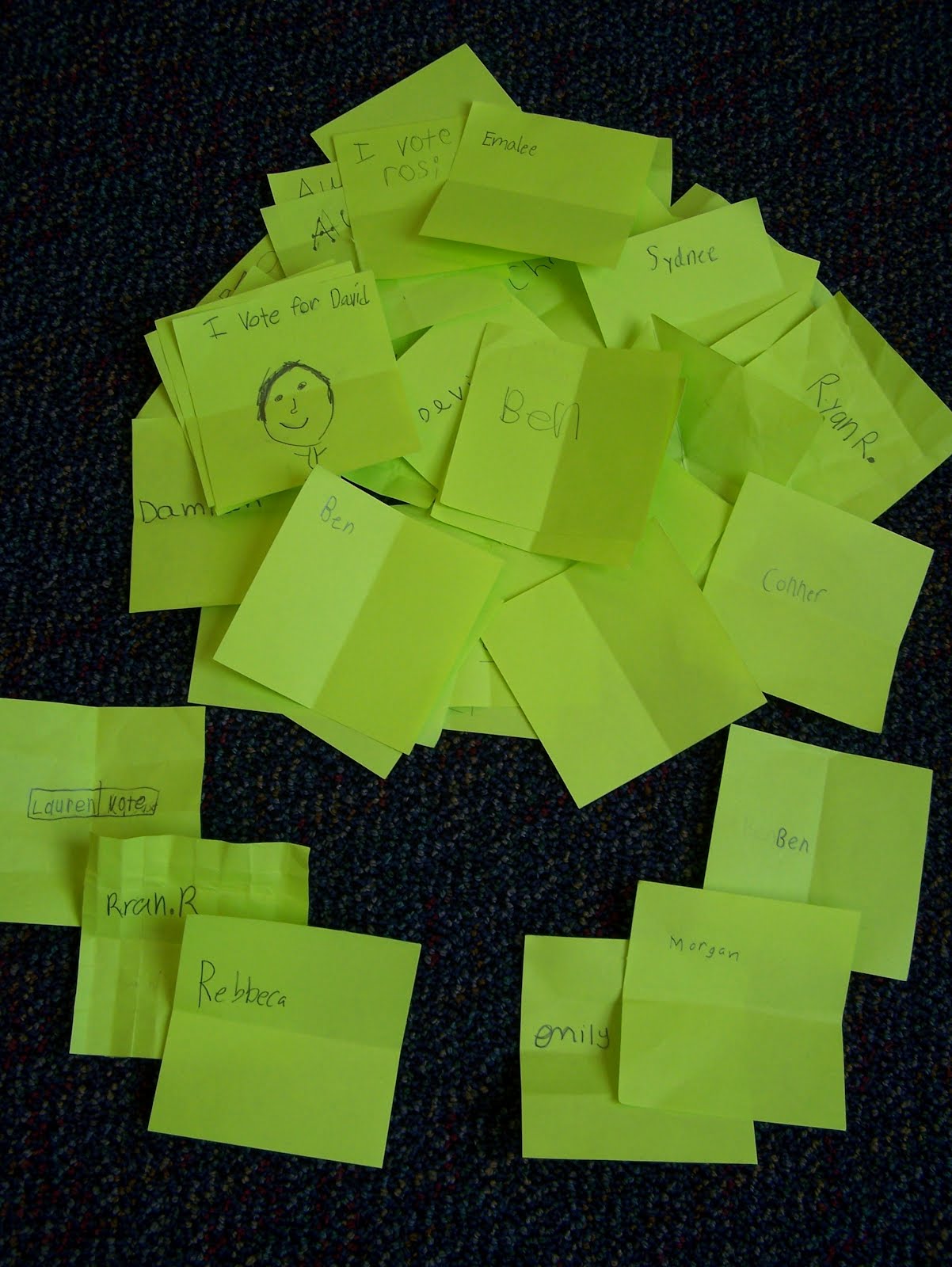
We held our first classroom election to vote for table runners. The students brainstormed expectations for the election process and table runner position, which we added to our Class Constitution.
We even made some amendments (in red) this afternoon and discussed how sometimes laws or procedures need to be changed to be more specific. Congratulations to Rebecca, Ryan R., Lauren K., Emily P., Ben, and Morgan who were voted by their classmates to serve as table runners for the next four weeks. Some students filled out job applications to be our class' political correspondent, so I look forward to turning over classroom government updates to them soon!