Monday, August 15, 2016

Points, Lines, Rays, and Angles

So many new things upstairs!  As we take in a new school year, this week we are starting Math with Geometry since it's all about observing and describing shapes!

As a third grader, your student's goal was to understand that shapes in different categories (e.g., rhombuses, rectangles, and others) may share attributes (e.g., having four sides), and that the shared attributes can define a larger category (e.g., quadrilaterals).  Your student should be able to recognize rhombuses, rectangles, and squares as examples of quadrilaterals, and draw examples of quadrilaterals that do not belong to any of these subcategories. (Need a refresher?  Check out this Study Jam: Classify Quadrilaterals .)


What do you notice about this swell?  How would you describe the waves?

Fourth graders must be able to draw points, lines, line segments, rays, angles (right, acute, obtuse), and perpendicular and parallel lines. Students must also identify these in two-dimensional figures.

Check out this Study Jam on Types of Lines. (Make sure you listen to/sing the karaoke song!)


Here's a Khan Academy video to introduce/review right, acute, and obtuse angles.

Look around the room where you are.  Do you see any of these figures around you?  Soon you'll start seeing them everywhere!  :-)

Wednesday, June 8, 2016

What are you reading this summer?

I am SUPER excited to check out this book from the public library and possibly add a copy to my classroom!

This has been the most popular book in our classroom library this year.  It is also available at the public library.  I will be taking my copy home to plan some park trips!


Monday, June 6, 2016

Survival Week: Staying Safe Outdoors


As we wait out Tropical Storm Colin, our lesson today was in perfect timing!  We discussed safety during camping or hiking, weather emergencies, and safety in bad weather.  Floridians need to be prepared for lightning, tornadoes, and hurricanes.


According to the National Weather Service, the difference between a tornado watch and warning is:


  • Tornado Watch: Be Prepared! Tornadoes are possible in and near the watch area. Review and discuss your emergency plans and check supplies and your safe room. Be ready to act quickly if a warning is issued or you suspect a tornado is approaching. Acting early helps to save lives! Watches are issued by the Storm Prediction Center for counties where tornadoes may occur. The watch area is typically large, covering numerous counties or even states.
  • Tornado Warning: Take Action! A tornado has been sighted or indicated by weather radar. There is imminent danger to life and property. Move to an interior room on the lowest floor of a sturdy building. Avoid windows. If in a mobile home, a vehicle, or outdoors, move to the closest substantial shelter and protect yourself from flying debris. Warnings are issued by your local forecast office. Warnings typically encompass a much smaller area (around the size of a city or small county) that may be impacted by a tornado identified by a forecaster on Radar or by a trained spotter/law enforcement who is watching the storm.


  • There are also watches and warnings for severe thunderstorms:
    • Severe Thunderstorm Watch: Be Prepared! Severe thunderstorms are possible in and near the watch area. Stay informed and be ready to act if a severe thunderstorm warning is issued. Watches are issued by the Storm Prediction Center for counties where severe thunderstorms may occur. The watch area is typically large, covering numerous counties or even states.
    • Severe Thunderstorm Warning: Take Action! Severe weather has been reported by spotters or indicated by radar. Warnings indicate imminent danger to life and property. Take shelter in a substantial building. Get out of mobile homes that can blow over in high winds. Warnings are issued by your local forecast office. Warnings typically encompass a much smaller area (around the size of a city or county) that may be impacted by an on-going severe thunderstorm.

    Friday, May 27, 2016

    Energy Transfer in Organisms

    Our final series of Science lessons will be on energy transfer in living things.

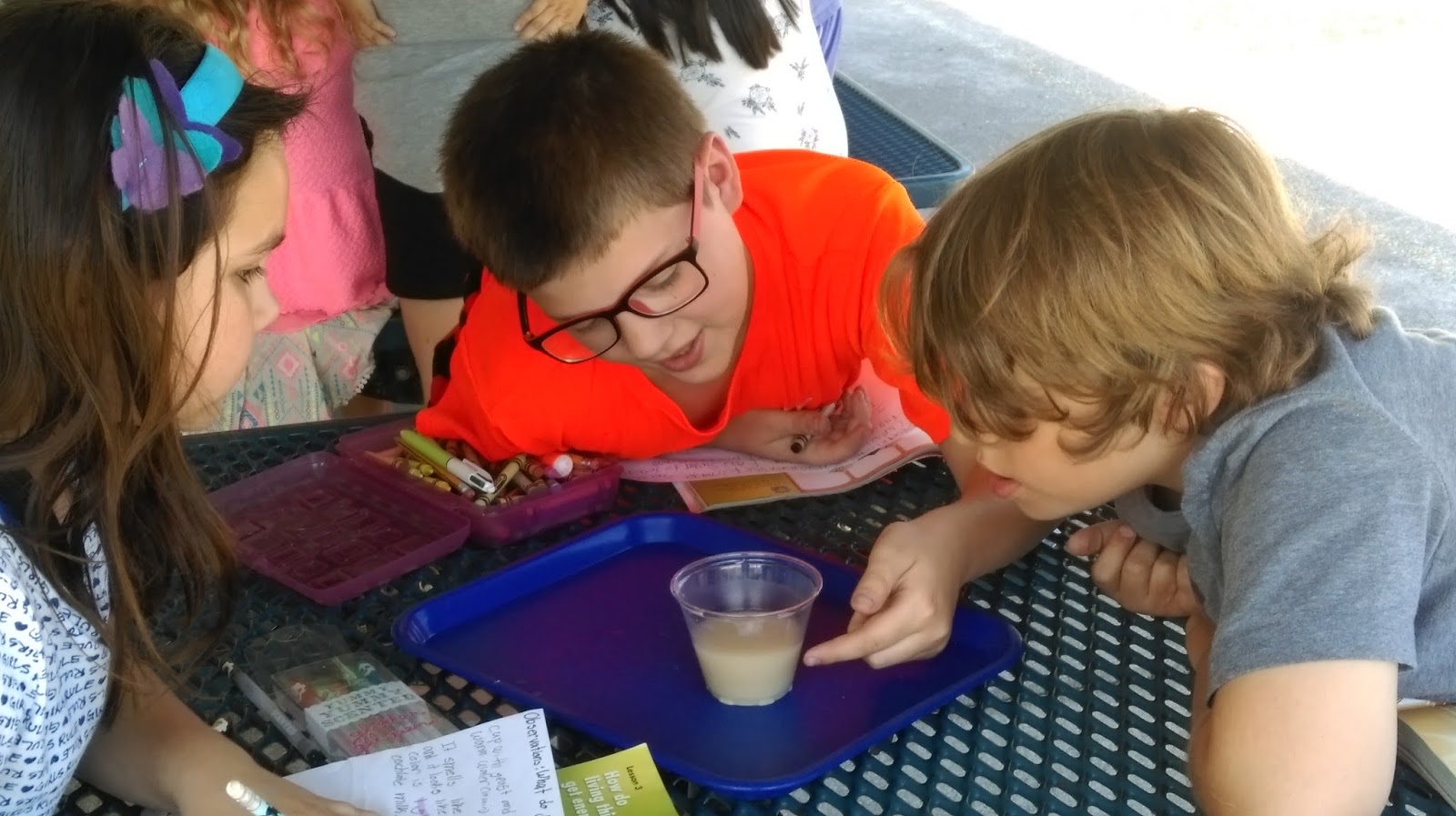
    Today we investigated: What do yeast use for energy?


    Energy is the ability to cause change or create motion.  We observed a mixture of yeast and water change from a "warm", "bitter"-smelling, "tan"-colored liquid to a "bubbly", "foamy" "cheesy"-smelling liquid after we added sugar.  A change in matter's (the mixture's) properties means energy is being transferred!


    Students will be able to explain that animals and humans cannot make their own food and that when animals and humans eat plants or other animals, the energy stored in the food source is passed to them.

    Students will trace the flow of energy from the Sun as it is transferred along the food chain through the producers to the consumers such as herbivores, carnivores, and omnivores. (Science textbook p. 333-335, 340-341)

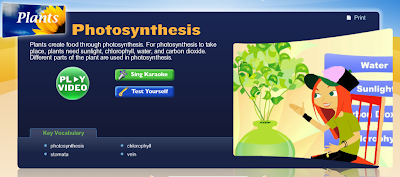
    Check out this Study Jam on photosynthesis!


    Check out this Study Jam on food chains!


    Wednesday, May 11, 2016

    Do Animals Hibernate in Florida?

    135625000

    We've learned that some behaviors are hereditary, or inherited from an organism's parents (instincts).  Adaptations are inherited traits or behaviors that help an organism survive in its environment.  When the seasons change, some animals hibernate or migrate to survive.  Florida is known for its mild winters, which caused us to wonder, do any animals hibernate in Florida?  Research led me to this interesting article.


    black-bears-hunt
    Mother bears instinctively protect their offspring.


    A Florida black bear cub clings to a pine tree. Florida Fish and Wildlife Commission photo.
    Isn't this Florida Black Bear cub cute?!  :-)

    During a class discussion this week, a student mentioned snakes hibernating during Winter here in Florida.  Through research, we learned that snakes don't technically hibernate.  They don't eat, so their body processes slow down, and they enter a dormant state, but they are still active, leaving their burrows for water.

    Tuesday, May 10, 2016

    Classifying Two-Dimensional Figures

    Students are classifying two-dimensional figures based on the presence or absence of parallel or perpendicular lines, or the presence or absence of angles of a specified size (right, acute, obtuse).  Students will also recognize right triangles as a category, and identify right triangles.

    Triangles can be classified by their side lengths:

    Equilateral triangles have all sides the same length.

    Isosceles triangles have at least two sides the same length.  (Can equilateral triangles also be isosceles triangles?)

    Scalene triangles have no sides the same length.,


    Triangles can also be classified by their angles.

    Equiangular triangles have all angles the same measurement in degrees.

    Right triangles have a right angle.

    Acute triangles have all angles less than right angles.

    Obtuse triangles have one angle greater than a right angle.

    Watch this Study Jam to practice/review classifying triangles.

    We will also classify quadrilaterals, which are polygons with four sides:

    Trapezoids have only one pair of parallel sides.

    Parallelograms have two pairs of parallel sides.

    Rhombi have all sides the same length.

    Rectangles have four right angles.

    Squares have all sides the same length and four right angles.  

    Watch this Study Jam to practice/review classifying quadrilaterals.


    Other polygons may be included where appropriate.


    Some figures have a line (or lines) of symmetry.

    Watch this Study Jam to practice/review lines of symmetry.


    Students will take a quiz on these benchmarks on Tuesday, May 17.

    Wednesday, May 4, 2016

    Florida Plants and Animals

    Our next series of Science lessons will be on life cycles of Florida plants and animals.  Students should be able to compare and contrast the major stages in the life cycles of Florida plants (flowering and non-flowering seed-bearing plants) and animals, such as those that undergo complete and incomplete metamorphosis.  We will also compare the seasonal changes in Florida plants and animals to other regions of the country.

    Sabal Palms are Florida's state tree.  (Have you noticed these have been planted up and down Atlantic and Beach Boulevards recently?)


    Sabal _palm

    According to the Florida Department of State, the Sabal Palm (Sabal palmetto) is the most widely distributed palm in Florida. It grows in almost any soil and has many uses, including food, medicine, and landscaping.  Sabal palms grow up to 65 feet tall, with a trunk of up to 2 feet in diameter.  Palms are non-flowering plants.


    Orange Blossoms are Florida's state flower.
    Blossom
    The blossom of the orange tree (Citrus sinensis) is one of the most fragrant flowers in Florida. Millions of these white flowers perfume the atmosphere throughout central and south Florida during orange blossom time.  Orange trees are flowering evergreens (don't lose their leaves from Fall to Winter) and are usually between 30 and 33 feet tall.


    Coreopsis is Florida's state wildflower.
    Coreopsis
    Coreopsis are found in a variety of colors ranging from golden to pink and are usually about 3 feet tall.


    American Alligators (Alligator mississippiensis) are Florida's state reptile.
    Gator
    In late June and early July, female alligators usually lay thirty to fifty eggs in mound-shaped nests made of reeds and other vegetation. Baby alligators hatch after an incubation period of about two months. When hatched, alligators are already fully developed and about eight inches long. Mature alligators usually range from six to twelve feet in length, with females rarely exceeding nine feet.  Female alligators are particularly aggressive when guarding their nests.  (Is this an instinctive or learned behavior?)


    Mockingbirds  (Mimus polyglottos) are Florida's state bird.
    Mockingbird
    Often, the mockingbird sings all night long, especially under bright springtime moonlight.
    Mockingbirds are usually about ten inches in length, with a fifteen-inch wingspan.  The nest, a joint project of the male and female mockingbird, is a bulky, open cup of grass, twigs, and rootlets carelessly arranged in a dense tree or bush. The three to six eggs per nest are a pale blue-green with brown spots. This year-round Florida resident is known for its fierce defense of the family nest.  (Instinct or learned behavior?)


    Did you know Florida has a state butterfly?  It's the Zebra Longwing!
    Longwing
    The Zebra Longwing (Heliconius charitonius) is found throughout the state, although it is more common in south Florida, particularly in the Everglades National Park.


    Florida Panther (Felis concolor coryi) is our state animal.
    Panther
    The Florida Panther is a large, long-tailed, pale brown cat that grows to six feet or longer.  The Florida panther is the most endangered of all Florida's symbols, and it was chosen in 1982 by a vote of students throughout the state.


    Manatees are Florida's state marine mammal.
    Manatee
    The manatee (Trichechus manatus), also called a sea cow, is a gray, waterplant-eating, gentle giant that reaches eight to fourteen feet in length and can weigh more than a ton.


    Dolphin/Porpoise is Florida's state saltwater mammal.
    Porpoise
    The terms porpoise and dolphin are sometimes erroneously used interchangeably. Usually in Florida both names refer to the Bottlenose dolphin (Tursiops truncates), the species commonly found along Florida's Atlantic and Gulf coasts. (True porpoises are a different saltwater mammal and are not commonly found in Florida waters.) Dolphins are gray with a lighter underside. They can live to the age of thirty and most are six- to eight-feet in length.  Dolphins use a system of echolocation, much like sonar, to determine their orientation (Instinct or learned behavior?). They have no sense of smell. Their keen eyesight, remarkable hearing, and wide variety of sounds (barks, clicks, and whistles) make dolphins especially interesting to study.

    Sailfish is Florida's state saltwater fish.
    Sailfish
    Sailfish (Istiophorus platypterus) are not unique to Florida; they are found nearly everywhere there is warm ocean water. However, Florida sailfishing is legendary, especially in the Fort Pierce, Miami, and Keys areas during colder months. Sailfish migrate southward as the weather chills in the north.  (Is migration an instinct or learned behavior?  How is it an adaptation?)  The sailfish can reach speeds of sixty m.p.h. The average size of sailfish found in Florida is approximately six to seven feet and thirty to forty-five pounds.

    Largemouth Bass are Florida's state freshwater fish.
    Bass
    Florida Largemouth Bass (Micropterus salmoides floridanus) seem to grow to unusually large size in Florida waters. They can reach a length of more than twenty inches and weigh more than fifteen pounds. 

    In my next weekly e-mail, I will e-mail the PowerPoint presentation we will use in class, so students can use it to review/study for home learning.